Interpretations
Since Schrödinger's time, other interpretations of quantum mechanics have been proposed that give different answers to the questions posed by Schrödinger's cat of how long superpositions last and when (or whether) they collapse.
Copenhagen interpretation
Main article: Copenhagen interpretation
A commonly held interpretation of quantum mechanics is the Copenhagen interpretation.[14] In the Copenhagen interpretation, a measurement results in only one state of a superposition. This thought experiment makes apparent the fact that this interpretation simply provides no explanation for the state of the cat while the box is closed. The wavefunction description of the system consists of a superposition of the states "decayed nucleus/dead cat" and "undecayed nucleus/living cat". Only when the box is opened and observed can we make a statement about the cat.[6]: 157
Role of consciousness
Main article: Consciousness causes collapse
In 1932, John von Neumann described in his book Mathematical Foundations of Quantum Mechanics a pattern where the radioactive source is observed by a device, which itself is observed by another device and so on. It makes no difference in the predictions of quantum theory where along this chain of causal effects the superposition collapses.[15] This potentially infinite chain could be broken if the last device is replaced by a conscious observer. This solved the problem because it was claimed that an individual's consciousness cannot be multiple.[16] Eugene Wigner asserted that an observer is necessary for a collapse to one or the other (e.g., either a live cat or a dead cat) of the terms on the right-hand side of a wave function. Wigner discussed the interpretation in a thought experiment known as Wigner's friend.[17]
Wigner supposed that a friend opened the box and observed the cat without telling anyone. From Wigner's conscious perspective, the friend is now part of the wave function and has seen a live cat and seen a dead cat. To a third person's conscious perspective, Wigner himself becomes part of the wave function once Wigner learns the outcome from the friend. This could be extended indefinitely.[17]
A resolution of the paradox is that the triggering of the Geiger counter counts as a measurement of the state of the radioactive substance. Because a measurement has already occurred deciding the state of the cat, the subsequent observation by a human records only what has already occurred.[18] Analysis of an actual experiment by Roger Carpenter and A. J. Anderson found that measurement alone (for example by a Geiger counter) is sufficient to collapse a quantum wave function before any human knows of the result.[19] The apparatus indicates one of two colors depending on the outcome. The human observer sees which color is indicated, but they don't consciously know which outcome the color represents. A second human, the one who set up the apparatus, is told of the color and becomes conscious of the outcome, and the box is opened to check if the outcome matches.[15] However, it is disputed whether merely observing the color counts as a conscious observation of the outcome.[20]
Bohr's interpretation
Analysis of the work of Niels Bohr, one of the main scientists associated with the Copenhagen interpretation, suggests he viewed the state of the cat before the box is opened as indeterminate. The superposition itself had no physical meaning to Bohr: Schrödinger's cat would be either dead or alive long before the box is opened but the cat and box form a inseparable combination.[21] Bohr saw no role for a human observer.[22]: 35 Bohr emphasized the classical nature of measurement results. An "irreversible" or effectively irreversible process imparts the classical behavior of "observation" or "measurement".[23][24][25]
Many-worlds interpretation
Main article: Many-worlds interpretation
In 1957, Hugh Everett formulated the many-worlds interpretation of quantum mechanics, which does not single out observation as a special process. In the many-worlds interpretation, both alive and dead states of the cat persist after the box is opened, but are decoherent from each other. In other words, when the box is opened, the observer and the possibly-dead cat split into an observer looking at a box with a dead cat and an observer looking at a box with a live cat. But since the dead and alive states are decoherent, there is no communication or interaction between them.
When opening the box, the observer becomes entangled with the cat, so "observer states" corresponding to the cat's being alive and dead are formed; each observer state is entangled, or linked, with the cat so that the observation of the cat's state and the cat's state correspond with each other. Quantum decoherence ensures that the different outcomes have no interaction with each other. Decoherence is generally considered to prevent simultaneous observation of multiple states.[26][27]
A variant of the Schrödinger's cat experiment, known as the quantum suicide machine, has been proposed by cosmologist Max Tegmark. It examines the Schrödinger's cat experiment from the point of view of the cat, and argues that by using this approach, one may be able to distinguish between the Copenhagen interpretation and many-worlds.
Ensemble interpretation
The ensemble interpretation states that superpositions are nothing but subensembles of a larger statistical ensemble. The state vector would not apply to individual cat experiments, but only to the statistics of many similarly prepared cat experiments. Proponents of this interpretation state that this makes the Schrödinger's cat paradox a trivial matter, or a non-issue.
This interpretation serves to discard the idea that a single physical system in quantum mechanics has a mathematical description that corresponds to it in any way.[28]
Relational interpretation
Main article: Relational quantum mechanics
The relational interpretation makes no fundamental distinction between the human experimenter, the cat, and the apparatus or between animate and inanimate systems; all are quantum systems governed by the same rules of wavefunction evolution, and all may be considered "observers". But the relational interpretation allows that different observers can give different accounts of the same series of events, depending on the information they have about the system.[29] The cat can be considered an observer of the apparatus; meanwhile, the experimenter can be considered another observer of the system in the box (the cat plus the apparatus). Before the box is opened, the cat, by nature of its being alive or dead, has information about the state of the apparatus (the atom has either decayed or not decayed); but the experimenter does not have information about the state of the box contents. In this way, the two observers simultaneously have different accounts of the situation: To the cat, the wavefunction of the apparatus has appeared to "collapse"; to the experimenter, the contents of the box appear to be in superposition. Not until the box is opened, and both observers have the same information about what happened, do both system states appear to "collapse" into the same definite result, a cat that is either alive or dead.
Transactional interpretation
In the transactional interpretation the apparatus emits an advanced wave backward in time, which combined with the wave that the source emits forward in time, forms a standing wave. The waves are seen as physically real, and the apparatus is considered an "observer". In the transactional interpretation, the collapse of the wavefunction is "atemporal" and occurs along the whole transaction between the source and the apparatus. The cat is never in superposition. Rather the cat is only in one state at any particular time, regardless of when the human experimenter looks in the box. The transactional interpretation resolves this quantum paradox.[30]
Objective collapse theories
According to objective collapse theories, superpositions are destroyed spontaneously (irrespective of external observation) when some objective physical threshold (of time, mass, temperature, irreversibility, etc.) is reached. Thus, the cat would be expected to have settled into a definite state long before the box is opened. This could loosely be phrased as "the cat observes itself" or "the environment observes the cat".
Objective collapse theories require a modification of standard quantum mechanics to allow superpositions to be destroyed by the process of time evolution.[31] These theories could ideally be tested by creating mesoscopic superposition states in the experiment. For instance, energy cat states has been proposed as a precise detector of the quantum gravity related energy decoherence models.[32]
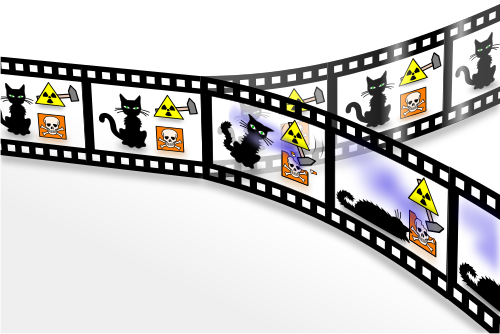
The quantum-mechanical "Schrödinger's cat" paradox according to the many-worlds interpretation. In this interpretation, every event is a branch point. The cat is both alive and dead—regardless of whether the box is opened—but the "alive" and "dead" cats are in different branches of the universe that are equally real but cannot interact with each other.