In quantum mechanics, Schrödinger's cat is a thought experiment concerning quantum superposition. In the thought experiment, a hypothetical cat in a closed box may be considered to be simultaneously both alive and dead while it is unobserved, as a result of its fate being linked to a random subatomic event that may or may not occur. This experiment, viewed this way, is described as a paradox. This thought experiment was devised by physicist Erwin Schrödinger in 1935[1] in a discussion with Albert Einstein[2] to illustrate what Schrödinger saw as the problems of the Copenhagen interpretation of quantum mechanics.
In Schrödinger's original formulation, a cat, a flask of poison, and a radioactive source are placed in a sealed box. If an internal radiation monitor such as a Geiger counter detects radioactivity (a single atom decaying), the flask is shattered, releasing the poison, which kills the cat. If no decaying atom triggers the monitor, the cat remains alive. The Copenhagen interpretation implies that the cat is therefore simultaneously alive and dead. Yet, when one looks in the box, one sees the cat either alive or dead, not both alive and dead. This poses the question of when exactly quantum superposition ends and reality resolves into one possibility or the other.
Although originally a critique on the Copenhagen interpretation, Schrödinger's seemingly paradoxical thought experiment became part of the foundation of quantum mechanics. It is often featured in theoretical discussions of the interpretations of quantum mechanics, particularly in situations involving the measurement problem. As a result, Schrödinger's cat has had enduring appeal in popular culture. The experiment is not intended to be actually performed on a cat, but rather as an easily understandable illustration of the behavior of atoms. Experiments at the atomic scale have been carried out, showing that very small objects may exist as superpositions, but superposing an object as large as a cat would pose considerable technical difficulties.[3]
Fundamentally, the Schrödinger's cat experiment asks how long quantum superpositions last and when (or whether) they collapse. Different interpretations of the mathematics of quantum mechanics have been proposed that give different explanations for this process.
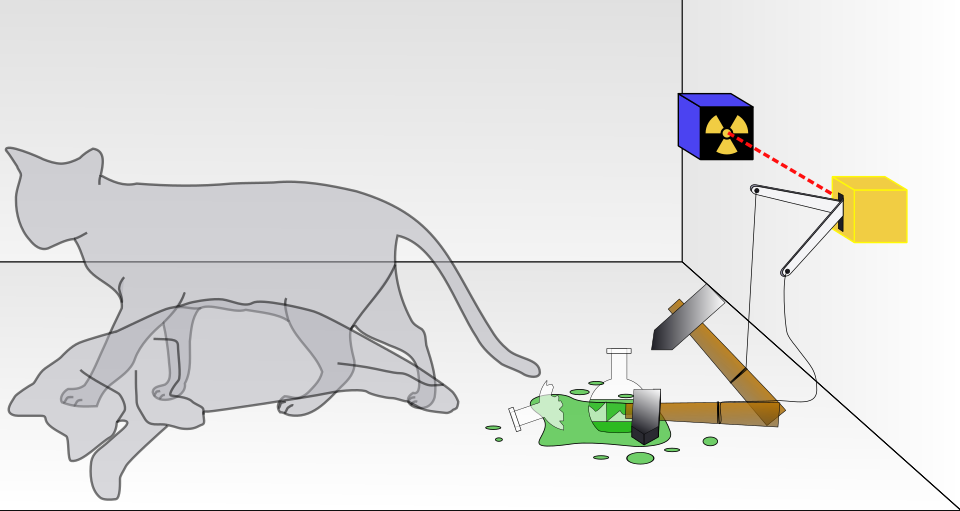
Schrödinger's cat: a cat, a flask of poison, and a radioactive source connected to a Geiger counter are placed in a sealed box. As illustrated, the quantum description uses a superposition of an alive cat and one that has died.
Origin and motivation
Schrödinger intended his thought experiment as a discussion of the EPR article—named after its authors Einstein, Podolsky, and Rosen—in 1935.[4][5] The EPR article highlighted the counterintuitive nature of quantum superpositions, in which a quantum system for two particles does not separate[6]: 150 even when the particles are detected far from their last point of contact. The EPR paper concludes with a claim that this lack of separability meant that quantum mechanics as a theory of reality was incomplete.
Schrödinger and Einstein exchanged letters about Einstein's EPR article, in the course of which Einstein pointed out that the state of an unstable keg of gunpowder will, after a while, contain a superposition of both exploded and unexploded states.[5]
To further illustrate, Schrödinger described how one could, in principle, create a superposition in a large-scale system by making it dependent on a quantum particle that was in a superposition. He proposed a scenario with a cat in a closed steel chamber, wherein the cat's life or death depended on the state of a radioactive atom, whether it had decayed and emitted radiation or not. According to Schrödinger, the Copenhagen interpretation implies that the cat remains both alive and dead until the state has been observed. Schrödinger did not wish to promote the idea of dead-and-live cats as a serious possibility; on the contrary, he intended the example to illustrate the absurdity of the existing view of quantum mechanics,[1] thus employing reductio ad absurdum.
Since Schrödinger's time, various interpretations of the mathematics of quantum mechanics have been advanced by physicists, some of which regard the "alive and dead" cat superposition as quite real, others do not.[7][8] Intended as a critique of the Copenhagen interpretation (the prevailing orthodoxy in 1935), the Schrödinger's cat thought experiment remains a touchstone for modern interpretations of quantum mechanics and can be used to illustrate and compare their strengths and weaknesses.[9]
Unsolved problem in physics
How does the quantum description of reality, which includes elements such as the superposition of states and wavefunction collapse or quantum decoherence, give rise to the reality we perceive? Another way of stating this question regards the measurement problem: What constitutes a "measurement" that apparently causes the wave function to collapse into a definite state?
More unsolved problems in physics
Thought experiment
Schrödinger wrote:[1][10]
One can contrive even completely burlesque [farcical] cases. A cat is put in a steel chamber along with the following infernal device (which must be secured against direct interference by the cat): in a Geiger counter, there is a tiny amount of radioactive substance, so tiny that in the course of an hour one of the atoms will perhaps decay, but also, with equal probability, that none of them will; if it does happen, the counter tube will discharge and through a relay release a hammer that will shatter a small flask of hydrocyanic acid. If one has left this entire system to itself for an hour, one would tell oneself that the cat is still alive if no atom has decayed in the meantime. Even a single atomic decay would have poisoned it. The psi-function of the entire system would express this by having in it the living and dead cat (pardon the expression) mixed or spread out in equal parts.
It is typical of these cases that an indeterminacy originally restricted to the atomic domain turns into a sensually observable [macroscopic] indeterminacy, which can then be resolved by direct observation. This prevents us from so naïvely accepting a "blurred model" as representative of reality. Per se, it would not embody anything unclear or contradictory. There is a difference between a shaky or out-of-focus photograph and a snapshot of clouds and fog banks.
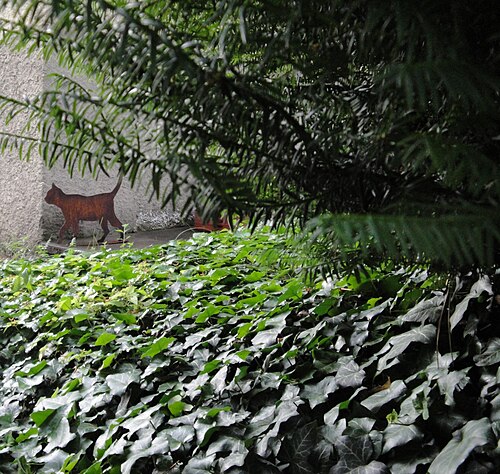
A life-size cat figure in the garden of Huttenstrasse 9, Zurich, where Erwin Schrödinger lived from 1921 to 1926. Depending on the light conditions, the figure appears to be either a live cat or a dead one.